A Pilot Car Driver? Really?!

In 2017, I found myself without a good source of income and thought “Well crap! What am I gonna do now?”
I was driving on Interstate 84 just east of Portland, Oregon and came up on a long, white, skinny thing on a trailer with regular looking cars in front and back. The semi truck hauling this trailer looked like a regular old semi truck, like the ones who have the big boxes. But the cars that were escorting this load had amber lights on the tops of their vehicles. They also had yellow signs with “OVERSIZE LOAD” printed in black letters on them. They both had CB antennas too. I recognized them as Pilot Cars I’d seen before with Mobile Homes.
I changed lanes into the fast lane and started around this weird looking and massively long load. As soon as I started to go past it all I could think was “If that guy comes over on me, I’m dead”. I don’t mind saying it spooked me a little. I didn’t mean to slow down, but that’s what I did. The Pilot who was behind the load switched over into the same lane I was in and flashed his headlights at me. I had no clue why he was doing this, but I mashed on it and got around that load as quick as I could!
I think all of us have seen the Pilot Cars who escort Mobile Homes. These were just like those. I had a basic idea of what their job was and I thought to myself; “Self, you could do that!”
Over the next few months I started to see more of these huge white things heading up I-84 and they seemed to come in all sorts of sizes and shapes. Finally I stopped at the truck stop in Troutdale, Oregon and asked one of the drivers of the “regular” sized semi’s what they were. “Wind Turbine Components” he answered, just a bit on the gruff side. Before I could think, I asked “What’s a Wind Turbine?”. The expression on his face spoke loudly and I got back in my car and left the truck stop.
During the 1970’s, there were a couple experimental Windmills up in Goldendale, Wa. Their blades were red and white. As a pre-teen kid I thought they were HUGE! They made a “Whoosh, Whoosh” sound and it seemed like the ground vibrated a little bit. It was crazy cool! After a conversation with my sister, I realized those old windmills up in the gorge were early versions of Wind Turbines.

I started looking around on the internet and found out what a modern day wind turbine was, how they were made, what the parts were and most of all, how they transported them. Then I started to research how to become a Pilot Car Driver in Washington State, where I live.
The biggest thing I learned, and damned quick, is there aren’t any classes ANYWHERE that a person signs up for and takes that teaches you HOW to become a Pilot Car Driver. This industry is based literally on the “School of Hard Knocks”.
The first thing I had to do was to get a certification to operate a Pilot Car. In Washington State the only place to get one was located north of Seattle. I was able to sign up and pay my $300 fee online for the course well in advance of when I had to actually attend it. I received a study guide in the mail and started studying. Now this was in 2018 and before “On-Line classes” or “Zoom” meetings were even a thing. Needless to say if you needed to get a new certification or renew your old one, you had to find a place to go to a class and not every state had a testing facility.
I live near the Columbia River, which is our state’s southern border and had to go within about an hour of our northern border. This meant I had to travel some 200 miles to get to the testing facility and spend a day in class. At that time, 200 miles was a long way to drive so I decided to head up there the day before, get a motel and be ready to go the next morning.
I arrived early and there were already a few vehicles there. More people started to arrive in all types of Pilot Cars. Passenger vehicles, Pick-ups, full size and minivans of all conditions were pulling in and parking. A few of these Pilots were getting out of their vehicles as though they had stayed the night in their rigs, right there in the parking lot! It kind of took me aback and made me a little curious. There was time before class where people greeted other Pilots they knew and pretty much every one visited with everyone else. I stood there listening and soaking in as much info as I could.
Then I noticed the license plates. Very few were from Washington State. They were from all over, there were even rigs with Texas plates. I actually laughed about it and said something to one of the gentlemen standing next to me. He nonchalantly said “Oh yeah, we’re from all over.” He asked if this was my first time getting my certification. Now, I’m sure by the expression on my face and the way I was gawking at all the rigs, I didn’t have to say yes, but I did. He chuckled and said “Welcome to the game!”.
What an understatement.
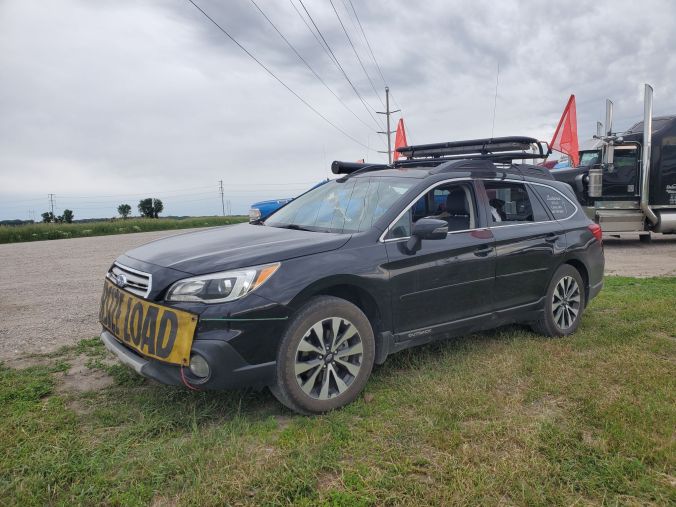
The class lasted about 8 hours. There was a test that had about 50 questions on it. They went over required equipment, safety, flagging basics, Oversize Load Permits etc. It was all super basic information about communicating with your team and how to keep the “Motoring Public” safe when traveling near and around an oversized load.
I really learned more about the job and what I needed to do to be ready to hit the road from listening and chatting with people who were in the class. There was a chapter in the study guide listing the basic equipment I needed to buy. There was also a little blurb about insurance. Standard car insurance wasn’t gonna cut it. In fact if I didn’t have commercial insurance, there wouldn’t be any of the heavy haul companies who would even talk to me.
After taking and passing my Pilot Car Certification test I drove home. The next day I started researching where to get my needed equipment for the vehicle and try to figure out what my options were for the insurance.
I was able to order most of the things I needed through Amazon. My first amber light bar was 18” long and plugged into my cigarette lighter. It had magnets to hold it onto the roof of my truck. I ordered 18” orange flags on wooden dowels, an 18” stop/slow paddle, A yellow high-viz construction vest, first aid kit, a handheld cb radio, a set of 3 collapsible triangles, 2 “OVERSIZE LOAD” banners and 3 orange plastic cones. About $300 later I had most of my basic equipment to get me going.
I picked up a fire extinguisher at Costco and I had an old beat up CB radio and antenna up in our family’s shop. I was shocked when I hooked it up in my truck and the damn thing actually turned on. As a CB’er in the ‘80s, I had a pretty good working knowledge of how to get it set up and how to use it.

I fiddled around with it in my driveway talking to local logging and construction truck drivers. It got out really good for its age and I was able to hear the drivers who were responding to me pretty well too.
Thank god for Google! I started looking for Commercial Insurance Companies and making calls. After a morning of phone calls and a couple pots of coffee this is what I found out.
Finding insurance companies who cover Pilot Cars were few and far between. They were also ungodly expensive. But I finally found a company up near Seattle that worked with a lot of logging companies and they insured Pilot Cars. I had a 2003 Ford F150 Crew cab and the commercial insurance for the year was over $3500. I found out later that amount was pretty cheap. I was in my early 50’s and had a perfect driving record.
I then learned I needed to have a business license. OIY! I was really overwhelmed at the amount of paperwork it took to get it. I worked for 3 days solid and had finally figured out a name I wanted for my business, got my business license application turned into the state and filed for my IRS tax ID number. About $500 later I felt good about my accomplishments.
But WAIT! I had no one to work for! I looked up a few companies who transported Oversize loads and they all said they went through “Brokers” for their Pilots. So I naively started my new entrepreneurial endeavor working for an unscrupulous broker I had met while taking my Certification Course. What a nightmare THAT turned out to be! He charged me a 25% broker fee, gave me absolutely no guidance and ended up owing me over $2500 after 3 months of working. I decided right there and then I wouldn’t be working for any broker based on this experience.
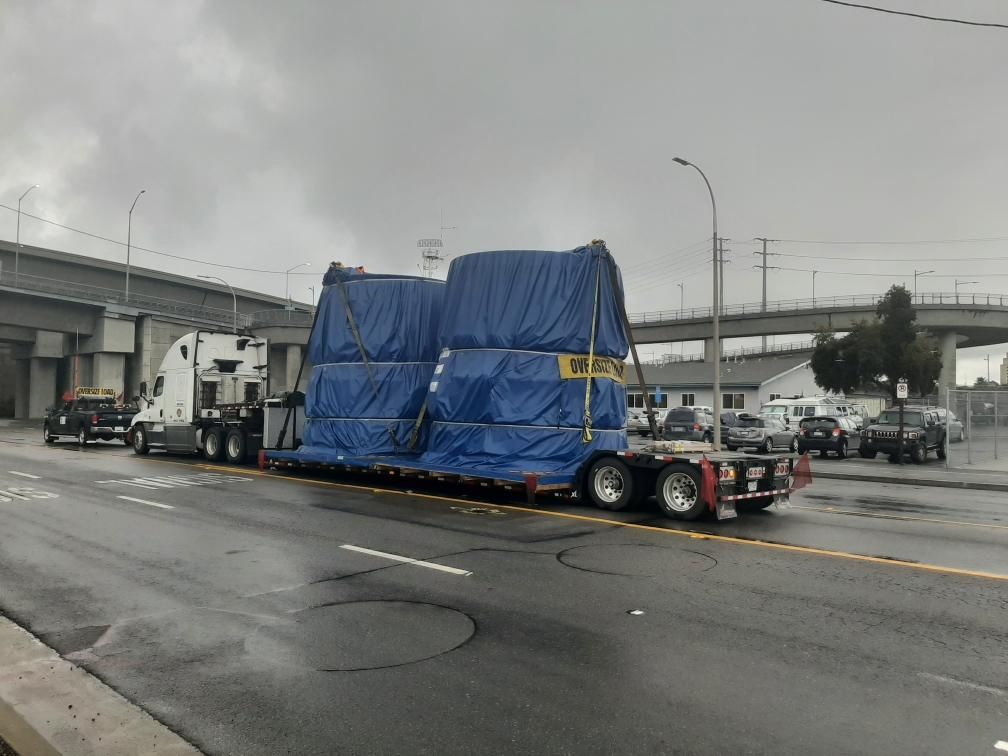
So once again, I had no one to work for. Well, Martha shit the damn bed! Back to the truck stop in Troutdale I went. There were quite a few Oversize loads parked behind the store and If I saw the driver was sitting in their seat, and awake, I’d ask if I could pick their brains about Piloting. I can’t remember a single driver turning me down when I asked them about the Oversize/Over Dimensional trucking industry. Sometimes it was the opposite. I could hardly get away from them!
I started taking notes and writing down the Company names from the sides of these trucks. Then I saw a weird looking trailer that had a sort of half round and lumpy thing on it. It was covered with white shrink wrap and as I drove over to it I saw the word “Goldwind” printed in blue letters on the plastic and realized this had to be a wind component. Turns out it was a “Hub”. This is the part that the turbine blades are bolted onto.
That one driver, who took time out of his day to talk to me about Piloting Wind Components literally changed the course of my Piloting career and was a key part of my becoming a Pilot Car Driver for Wind Energy. I can’t remember his name or who he drove for and I’ve never seen him again.
Since then, I’ve been as far as Western Tennessee, Escorted Blades out of the Port of Houston, Texas, ran with components into Alberta, Canada and all over the midwest. I’ve made a pretty good living out of Piloting and met/made friends with some really extraordinary people from all walks of life and from all over the United States and Canada.
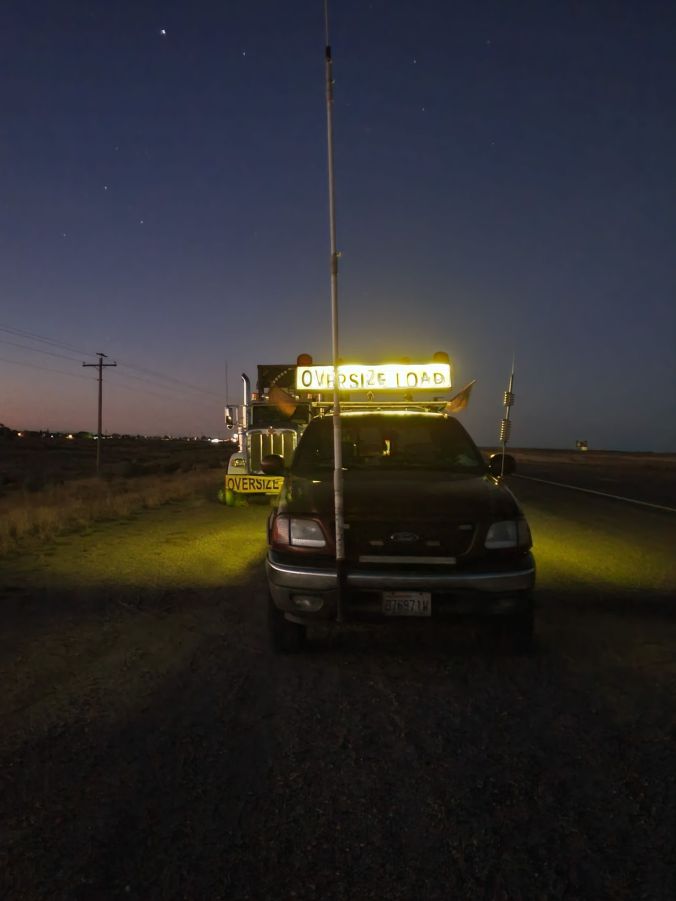
I’ve been Piloting pretty much just in Wind Energy. It’s not that I’m opposed to Piloting other types of Oversize/Overdimensional loads; I just really enjoy wind loads. Most of them are classified as “Super Loads” which are most commonly over 16” wide, 16” high’ at least 125” long and 200,000lbs or above.
No matter how many times I see these monster sized component loads, I’m blown away by them. Just the logistics it takes to get them from one place to another is mind-boggling. When you add the amount of people involved in getting them transported, the crews and equipment it takes to not only load them on and off the trailers but the people involved in actually putting all the pieces together and getting them set up in the wind farms, it’s really unbelievable.

I got side tracked there and all that mess will be saved for another blog post. Piloting is definitely not for everyone. I’ve learned how to save my money for lean times. I’ve had to learn how to pee between the open doors on my rig as with these loads there isn’t always a restroom readily available. I’ve learned how to deal with different types of personalities which has made me a much more tolerant person. The endless waiting for permits has taught me patience. But I think the biggest thing I’ve gotten out of piloting is this: it’s truly a way of life. When people ask what I do for work, I tell them I’m a Pilot Car Driver. Most people look at me a little on the befuddled side and say “Oh”. It always makes me chuckle.
Keep an eye out for more posts on piloting.
 Miss Sarah Etc.