Introduction to Free-Form Crochet

Ditch the patterns, be creative and have a blast!

As an Amazon associate I earn from qualified purchases.  Links at the end.
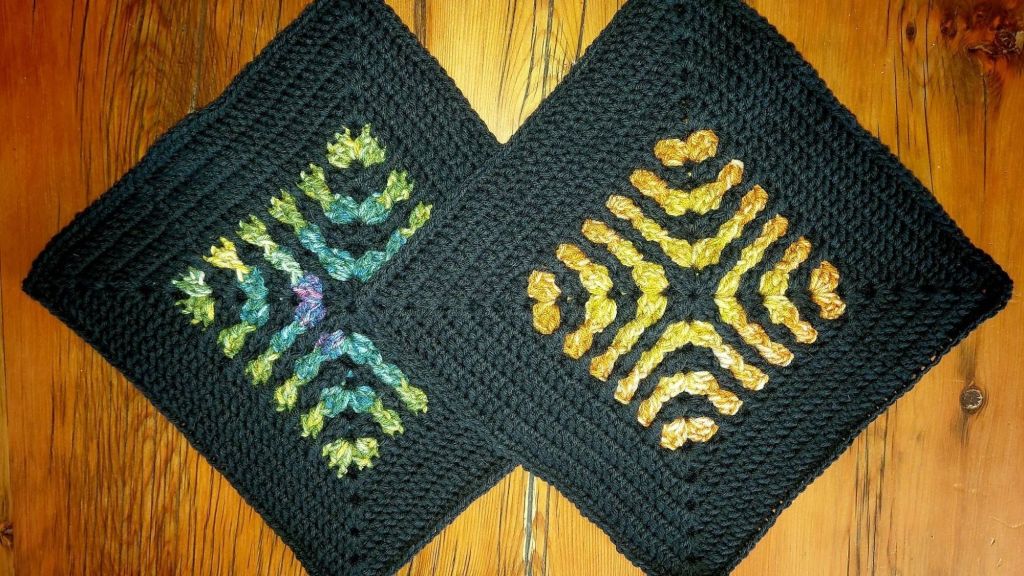
Pot holders are a great way to start figuring out Free-Form crochet.  Start with a basic granny square pattern.  These pot holders are made up of ch, sc, dc and tr.  ALWAYS use stitches you’re familiar with.

I think it was Paul McCartney who said

“I don’t go to therapy, I have my music and that’s my therapy”. 

I totally get it because after nearly 50 years of crocheting; crochet is MY therapy.  

As with anything that any of us may enjoy doing; my crochet abilities kept growing until my understanding and talent grew until I got to the point where I found myself  bored with the same old stitches being used in the same old order.  

I could change things up by using new fibers such as Bamboo (a SERIOUSLY advanced type of fiber to work with!), or Merino Wool. I still got bored with the easiness and needed a challenge.  I started seeking out advanced patterns wherever I could find them.   
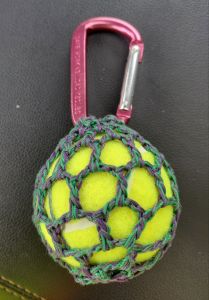


To the left is a really simple example of Free-Form Crochet.   A truck driver I work with asked me to come up with something he could throw over a load with a light rope attached for pulling heavy straps over the top to avoid damaging Wind Components.   I had an extra Tennis ball (Thanks to my road dog Dakota), an old carabiner and #10 crochet thread from my doily bag.  Using 2 strands of crochet thread, sl st and ch I made a net bag around the ball and closed it at the top by working the carabiner into the loops of the net bag.  Easy peasy!  Months later, the driver is still using it. 


With the world at my fingertips and the irritatingly quirky sound of Dial-up internet;  I found a what seemed like never  free crochet pattern websites. No more ordering pattern books from Annie’s Attic or Kirschner’s.  I even had a subscription to a small sized crochet pattern magazine, whose name completely escapes me but as they say “if you know, you know”.  *Insert here 5 minute blank stares at the wall while biting my lip in a vain attempt to remember the name of the aforementioned crochet magazine.

Although “I was wet your pants” excited about all these patterns I was able to store in a cool little folder on my dial up computer;  it was really just the same stuff over and over.  Well DAMN it!  Don’t get me wrong, I made some beautiful clothing, home decor and just general bazaar type stuff that made its way to many-a-thrift  store donation box.  

ENTER FREE FORM CROCHETING!  
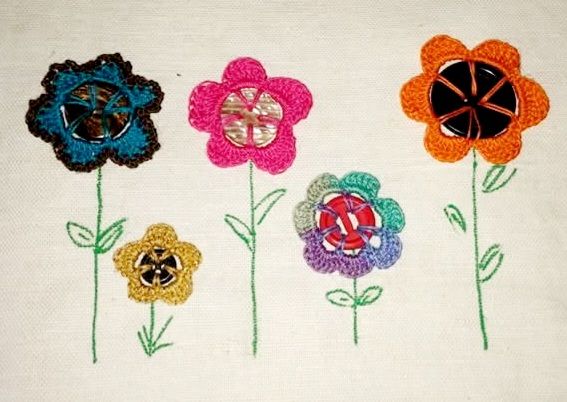
These Free-Form form flowers were made with vintage buttons and   size 10 cotton crochet thread.  When choosing buttons to make flowers with, choose ones with holes big enough for the hook your using to go throught the holes.  I used a size 7 steel crochet hook for these. Stitches used:  sc, dc, tr, dbtr, ch and sl st. I used a fabric pen to draw stems and leaves.  They turned out so Cute!

After surfing Pinterest for crochet projects I stumbled on a Free Form applique flower pin.  There was no pattern.  I thought “why wouldn’t they include the pattern?”.  I kept reading on and realized there WAS NO PATTERN!  I must have looked for a pattern within the pin for 10 minutes! Finally I started to study the crocheted flower image trying to figure out how they’d done it.  

It didn’t take me long to figure out the stitches used were dc, sc and ch.  Easy peasy!  After fudging around with these simple stitches and studying the image from the Pin, VOILA!!!! I had it!  My first try at Free-Form crochet was a complete success!  

This epiphany was such a game changer for me.  I started looking at images of crochet patterns, zooming in and dissecting them.  This meant I sometimes had to download the images and really look close at what stitches were used.  But not just the stitches, but the size of the yarn which was used too.  

I think one of the first crochet projects I tried as a kid was a potholder so I thought this would be a great little project to try for my first Free-Form project.  As I was crocheting a long I realized I had been doing Free-Form crochet off and on for years and just didn’t realize it had an actual name.  
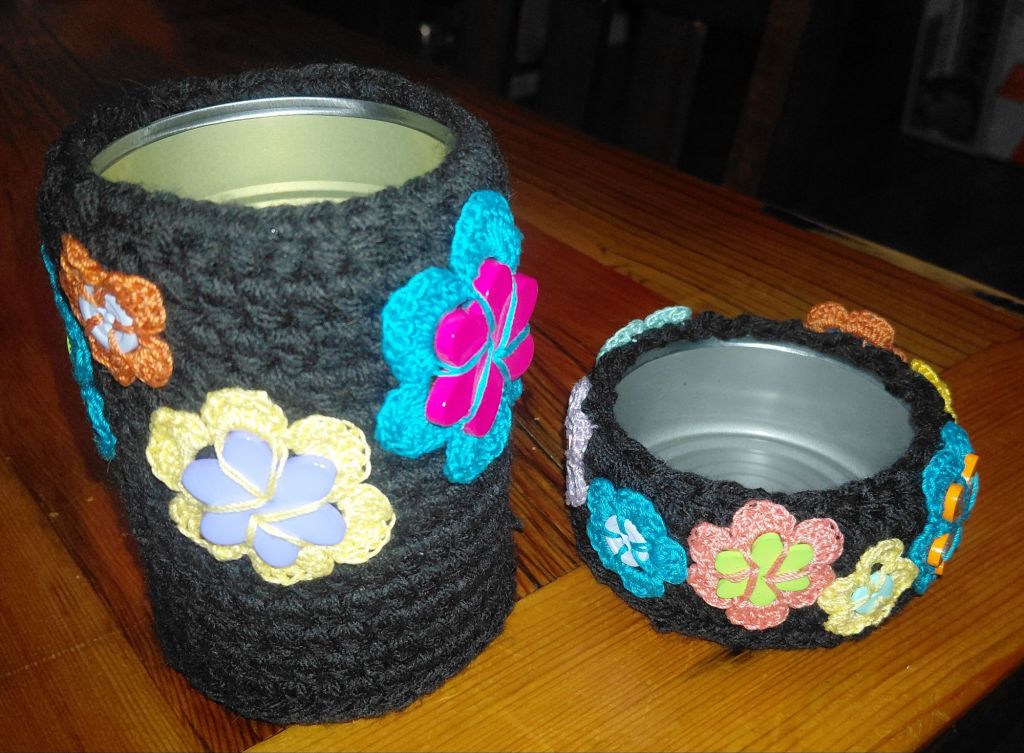

A very basic desk set using veggie and tunafish cans.  After peeling off the paper labels and running these cans through my dishwasher, I used worsted weight yarn to crochet a sleeve around each can using sc.   When I got them tall enough to be just above the edge of the can I used a yarn needle and wove worsted weight yarn around the top, pulled on it a bit to go over the edge of the can, tied it off and tucked the ends of the yarn down in between the can and crocheted sleeve.  I keep a bag of crocheted motifs in my yarn stash and have them handy for projects just like this.  There were a bunch of button flower motifs and they worked perfectly for this project. 

What I needed was a crash course on new crochet stitches.  Pinterest has been a mind boggling experience when it comes to finding new crochet stitches and methods.  I started a sub-board titled “Stitches” within my crochet board.  At this time this board  is up to 115 pins on JUST crochet stitches.  

I see my crocheting in a whole different light.  I now get an image in my head of what I want to make and combine the stitches I know to create a finished project.  This didn’t happen overnight though.  I consider myself to be in between a moderate to experienced crocheter.  I did have to break the habit of looking at a pattern.  I keep a notebook near my crochet chair for notes on more intricate or repeat stitch patterns.  

HOLY MACKEREL!!!!  

I have a few tried and true Afghan and sweater patterns in which I use the basics of the pattern and go from there. I call this “the bones” or the basic structure of the pattern.  One of those patterns is “Baby Rings”; a mile a minute baby Afghan pattern from a pattern book I bought from Annie’s Attic years ago. Except for the basic rings I have changed that pattern every time I make one.  I’ve added clusters, PC’s,  DC’s, TR’s which are pretty basic crochet stitches.  After learning stitches like Bead, larksfoot, bullion and box stitch the end product has turned from the same old, same old into intricate and eye-catching works of art.   
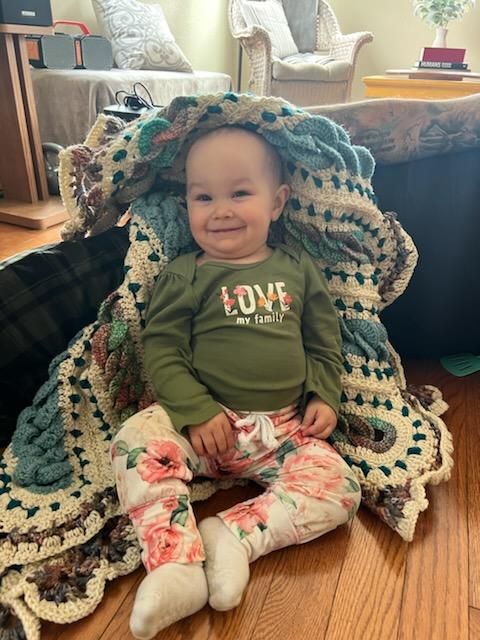

Above is one of my versions of the “mile a minute Baby Rings” baby afghans I’ve made.  This beautiful little girl lives in Calagry and her daddy and I worked together on an 83m wind turbine blade project going from Washington State to Hannah, Alberta in Canada.  I changed things up by using non-traditional worsted weight colors instead of pastel baby colors.  Adding cluster and popcorn stitches added texture.
 

I’ve probably made a dozen of these little baby afghans and each one is different.  The only thing that stays the same are the bones of the original pattern which are the rings.  I call them “Snuggies” and make them for friends and family who are expecting.  For whatever reason babies like texture and lots of color. For me, being able to make something in which people of all ages really like and USE is the most flattering compliment they can give me!  

Take the time to learn new stitches and start easy by making swatches of Free-Form crochet.  The worst thing about this method of crochet is Frogging and this is where the practice swatches come in as a useful tool. There really aren’t any rules to follow. There aren’t any classes to take or real instructions to follow.  Dig around in your scrap yarn for a ball of old yarn, find your favorite hook and let your stitch knowledge run wild. You’ll be surprised at what you come up with.  This is such a fun and ever changing way to change up your crochet game. 

Check the examples of my Free-Form and let your mind go crazy! 

Happy Crocheting!  Later Gators,  Miss Sarah  

Links to Materials Iive used to make my Free-Form projects.  I’ve used these brands for years and stand by them 100%.  Some brands, Boye crochet hooks are the only brand I use after trying others just to donate them to stick with what works best for me. 
https://amzn.to/4e278H3

https://amzn.to/4x9gwBu

https://amzn.to/4vmRbCq

https://amzn.to/49F3phx

https://amzn.to/4wZAHlk

DRY HEAT OR HUMID HEAT?  NOPE TO BOTH!

I was born and bred in SW Washington State, where we might see a weeks worth of temps over 95 degrees during the summer.  As a pilot car driver, I sometimes work in the midwest.  This summer, I’ve found myself  working in both the midwest and southwest.

After telling a few friends about my having to pilot super loads from Iowa to Arizona, I heard nothing but “Arizona’s hot, but it’s a dry heat.”  What the hell?!  Hot is hot, I’ve never cared if it was dry or humid. Boy,  was I in for a steep learning curve!

Let’s start with Iowa.  My first day in the South East corner of the state where the laydown yard for our wind turbine components were stored and along the Mississippi River the temperature was 85 degrees and I thought “that’s not so bad.”  Then I got out of my nice cool car and tried to take a deep breath.  The first feel of that humid and hot air took my breath away.  It seemed my skin started to feel sticky within a few seconds.  I could FEEL the sweat, starting to form on my neck and back.  

That first experience with truly humid summer weather was completely overwhelming. For those of you who were born and raised there, I can hear you chuckling or sighing a huge, irritating sigh. 

This was my first trip to the midwest during this type of weather.  I had worked there in the winter and loved it. I was used to driving and living in cold weather.  This was completely different than anything I had experienced.  I tried to work on a doily I was crocheting and found the thread just wouldn’t glide through my fingers.  My steel crochet hook stuck to my fingers and hands. 

As the sun started to go down, a whole new bunch of experiences started to happen.  Bugs that will eat the livin’ crap out of you in an instant!  We have mosquitoes at home in Washington, but the ones that are in the midwest are on a different level.  They’re tiny, don’t make a sound, and seem impervious to any type of bug spray.  There is also some sort of “No-see-um” that will chew through any type of clothing right into your skin.  After that first night of sleeping in my car with the windows down, I had dozens of bites all over me.  Even my little road dog, Dakota, had bites all over the top of her head like little raised pimples. 

Then I started seeing tiny little flashes of light that seemed to come off the stalks of corn in an adjacent field, which butted up against the parking lot of the truck stop I was parked in. Now I’ve heard stories from family members about Fire Flies or Lightening Bugs; whatever it is a person wants to call them. But to see them for real and the realization that those people who told you stories of collecting them in jars, pinching off their little butts to put on your fingernails or ear lobes as earrings were telling the truth!  There really was such a thing as a bug that lit up;  they did fly,  and I was scared shitless of them.  I just couldn’t wrap my head around an insect that really did this.  I’m getting used to seeing them, but it’s taking me a while not to jump out of my skin when walking Dakota out after dark and these little streaks of light flash into the air. 

So let’s move on to Arizona.  My first experience with Arizona was this: at about 95 degrees my 2016 Subaru outback decided “screw this, I don’t like this heat and I”m gonna make your A/C go all wonky on you.”  Which it did.  I had it on the lowest temp I could go and the fan all the way up.  Nothin’  it was blowing hot air.  If I sped up it would kind of work.  But I’m a high pole car, running about 3/4 of a mile in front of my blade and have to pace my driver with the load behind me so that I’m not too far out for them to hear me or too close for them to maneuver around an obstacle in the road or vehicle pulled over on the road when I call it out on the cb radio.  So this means my speed stays at about 55-60 miles an hour.  

I finally decided to shut off my A/C and put the windows down.  It was horrible, but we had air flow.  After a while, Dakota had drank all the water in her bowl.  She started drinking it out of my water cup and it went ok for a while.  Then she started to really go down hill, laying on her side and panting hard.  Our load with the blade and the truck is over 200 feet long.  We don’t fit in most places and just parking on the side of the road is a safety hazzard to the motoring public.  We had about an hour to get to our destination in Arizona, so I told our blade crew of 3 that we’d just push through and onto our laydown site.

We got to the laydown yard and I rushed Dakota to a friend of mine who was waiting with cool, wet towels and functioning A/C in her pick up.  I made a call to my Subaru Guru in Washington, who referred me to a Subaru Guru in Phoenix.  It was 113 degrees while we were on our way there. We finally  arrived that night and found a nice comfy truck stop to stay in overnight.  It was a tolerable night with the temperature going down to about 80- 85 degrees. For whatever reason, it didn’t seem that warm.

The next morning we dropped my car off at the home based shop of my Pheonix Subaru Guru mechanic and took off in my friends pick up.  We found a gorgeous park and went for a walk to look at flower beds, the small lake with fountains in the middle of it and for Dakota to run around.  I realized there wasn’t the hot and sticky feeling I’d experienced in the midwest.  My skin wasn’t soaking with sweat. It was very hot at around 10am.  I think it was upwards of 90 degrees, but it honestly didn’t feel that hot.  I just can’t explain it, I know it wasn’t just me, my friend mentioned it too.  As we were looking at flowers growing in outdoor flower beds that I can only grow in my house where they can sit in a sunny window; we also realized we hadn’t been chewed up by bugs overnight.  Not a single bug bite!  We slept in peace all night with our windows all the way down too! 

The only real bug I saw were huge bumble bees flying unbievabley slow between flowers in the grass of the park.  We saw warning signs of scorpions and rattlesnakes, but thankfully, we didn’t see any of those. 

We spent most of the day in the Pheonix heat, but it seemed like I adapted to it pretty quick.  Weird huh? It was about 105 dgrees, but with out the added sweatiness of humid heat it was bearable.  I picked my car up in the late afternoon with working A/C and we left town about 5ish to head back north to Iowa for another load. 

I have to say I know exactly what people are talking about now when I hear them say, “it’s a dry heat”  when talking about the southwest united states.  There is truly a difference between humid heat and dry heat.  After being in both with in such a short period of time,  I have to go with the dry heat of the southwest.  For me, it isn’t as miserable as the humid heat we experienced in the midwest.  Even though I live in the cooler climate of the Pacific Northwest, I found that I adapted to the dry heat of the southwest much better than the hot and humid climate in the midwest. 

Pot Holders made for BIG hands

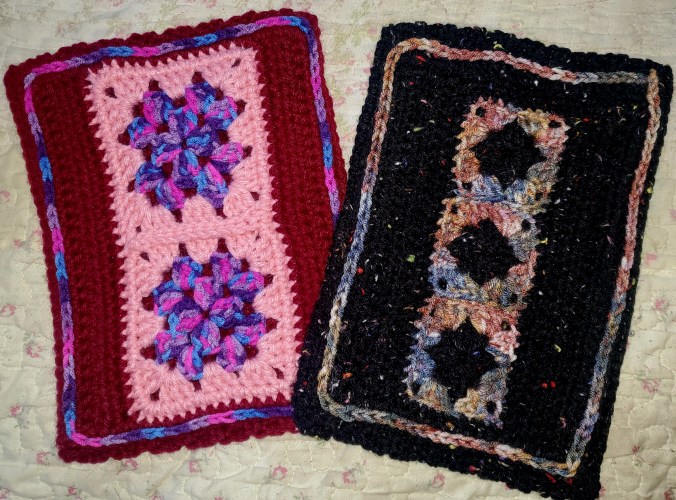
Stitches used: Slip Stitch, half double crochet, double crochet

Why are manufactured pot holders so little and thin? If you grab a hot pan out of the oven in MY kitchen, by God and sunny Jesus you are NOT gonna burn your hand!

I have a lot of scrap yarn left over from my various crochet projects. I save every bit of it too! It gets rolled up into little balls and stuffed into an old beat up Safeway paper grocery bag. I keep all sized pieces of yarn from a yard long and up. The little bitty pieces, get tied end to end and then rolled into a ball about the size of an orange. I use this ball for small projects that provide me with what I call “Instant Gratification Projects”.

Instant Gratification Projects take about as long to make as an episode of “Coach” lasts. They take zero thought and even less effort. Most all of us who these projects cause they’re done in a flash and you can look at the finished product and say to yourself “Looky what I did!?”.

Does that sound silly? Well, duh! Of course it does but the big take away is the Gratification of finishing a project. No matter how big, or in this case, how small. It may just be a scrap granny square that you add to a pile of other scrap granny squares to crochet together to make a scrap blanket with but you’ve finished it in no time! *please take into consideration all of us have projects sitting somewhere in a bag that’re only partly complete, that we’ll get to “tomorrow”.

Enter the homemade, crocheted Pot Holder. The method I use to make these is now referred to as “Free-form” crochet. I used to call it “winging it” as I’m sure most other old timers did. Free-form crochet doesn’t require a pattern no matter what you want to make. I guess this is Free-form crochet in it’s simplest form and you really don’t need a pattern to make these but you need a basic idea in your head of how you want it to look. I keep all the extra motifs, granny squares, parts of crocheted borders I’ve made up to see if I like them etc in a zip lock bag just to use for pot holders. If you don’t have any extra parts crocheted and stashed somewhere; grab your favorite hook, make a chain or circle or whatever turns your crank and just start to crochet!

Even beginners know a few stitches. It hasn’t got to be fancy, don’t chew on what or how you’re gonna do it, but here is the important thing to remember that a lot of us overlook when making these; SAFETY!

Size and Thickness *insert 12 year old giggle here*. It’s true though, when I grab for a pot holder in my kitchen, it’s to pull out a 400+ degree metal pan from the oven to get on the counter quick. I want to make sure I don’t burn my hand or my pretty counter tops.

Crochet a shape, lay it down and put your hand in the middle of it. If your fingers hang over the edge of your crocheted piece, you got a ways to go! I always make sure I have at least 2″ of space bigger than the size of my hand. I have sausage fingers, pure and simple. If it’s a horse call it a horse. Occasionally, people with bigger hands than me have to get something out of my oven. Mostly I worry about a man or Amazon size Lady Friend. It doesn’t matter who it is, I don’t want someone burning their hand using a pot holder that’s way too small.

There are always 2 layers to my pot holders. So after you get your first side the size and shape you want it, make another one. It doesn’t have to be the exact match of the first one. It can just be one color. Make it as close to the size of the first one as you can. After all, these are going to be used as “Trivets” too. A Trivet is something you sit on your counter to put a hot pan on. Another reason to make them good and thick.

After you get the second side done, lay one on top of the other and figure out how you want to crochet them together. In the first photo, I’ve Slip Stiched the 2 sides together on both pot holders because one side was just a smidge bigger than the other. This works out great! In the second photo, I did a single crochet stitch clear around. Both layers were close enough in size, so I simply crocheted singles through both layers.

20250202_0959062481074296094184179
Stitches used: double crochet, single crochet, slip stitch

In the photo above, I used a basic shell to crochet the 2 sides together. For the brown one on the left, I added a slip stitch row just to play around with it. As far as weaving in the ends; I insert my hook in between the 2 sides and near the middle of one side. Which side doesn’t matter. Work the hook through those sides up to where there’s a hole at the tail of the yarn. Yarn over and pull the tail in between the sides. Give your pot holder a stretch and the end of the yarn should disappear inside. If not, pull it just a little tight, snip off the end and then give it a stretch and your tail will be pulled inside the potholder. Don’t worry, I’ve not ever had one come apart on me in all the years I’ve been making these.

I work with a lot of bachelors or gentlemen who are the cooks in their homes. Every single one of them are shocked at these simple pot holders. The comments always seem geared around “it’s actually BIG enough for my hands”!

You can’t buy these in any stores, they’re easy to make and last forever. I use acrylic yarn and have not had an issue with them scorching from a hot pan. If you get “whatever” baking goo on them just pitch them in the washer/dryer and call it wonderful!

That’s it my babies! Use your imagination and as always HAVE FUN!

Garage Sale fabric = inexpensive and fun clothing

I always look for fabric at Garage Sales.  The blouse on the left cost under $10 to make including the appliqued flowers.

1004151515 The flower appliques are made from buttons I had in my button can and I used various shades of size #10 crochet thread to made crocheted button flowers from a picture I saw on Pinterest.

There wasn’t enough of one color of either piece of fabric to make a whole blouse in my size.  I really wanted the body to have the light color fabric, which has a vertical stripe.  I dug around in my fabric stash and Bingo!  I  found another chunk of fabric I had for years and it was the perfect accent color for the sleeves, button strip, etc.

Never pass up that garage sale stuff.  Put as many of your crafting talents into your project.  I’ve turned this blouse into a showcase of a few of my garment constructing abilities.  Wear your art!