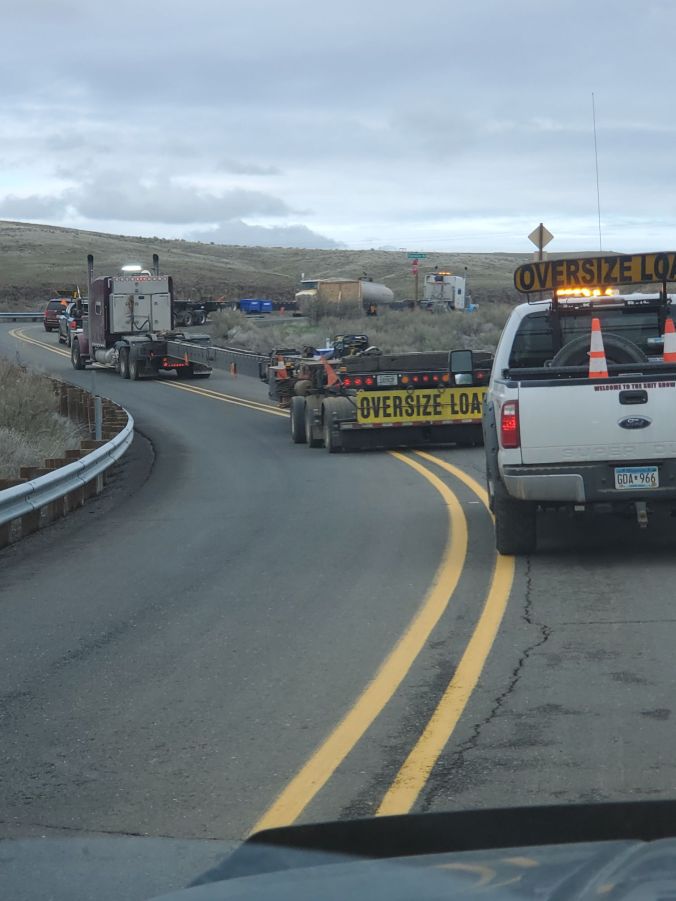
“You gotta run the zipper across this bridge”, “We’re gonna have to shoo-fly this pork chop to make it around the left turn”
This is a partial list of Lingo used while piloting oversize/over dimensional loads to help out new PEVO’s who are unfamiliar with industry specific Lingo. Most of these terms are used continually by all members of an oversize crew including the truck driver, front door/pole car, back door and steerman.
PILOT CAR LINGO
Every industry has its own lingo and Oversize/Over dimensional Pilot Car Drivers are no different. This mostly incomplete list will give the Pilot Car Driver, AKA Escort, AKA PEVO (Pilot Escort Vehicle Operator) a good working knowledge of commonly used Oversize terms used to perform your duties as a Pilot Car driver along with some lesser used terms.
There are no training classes per se. Other than the instruction and testing you’ll get when you go through your PEVO certification course; this industry is pretty much all “school of hard knocks” e.g. learning as you go along. This glossary of Pilot Car terms is to help Newbie Pilots. To help them navigate their first few trips until saying these well recognized terms not only helps you to familiarize yourself but it will help you to become a valuable part of any Oversize team.
FOUR Any 4 wheeled passenger vehicle driven by a regular motorist.
TAG A trailer being towed behind a vehicle. e.g., “4 with a tag on the shoulder”
ALLIGATOR More commonly called a GATOR. These are shredded pieces of tires laying in or along the side of the road. *When the tread is facing up, they resemble the backs of alligators.
MUSTARD The yellow striping to the left of lane 1. *The inside or left lane.
FOG LINE The white line at the right edge of the outside right lane (on multiple lane roads) or at the right side of the lane you are traveling in.
ZIPPER The broken lines separating the lanes or 2 way traffic.
UP Used by the Chase car or Steerman to let the driver know a vehicle is going to pass the load. e.g. “4 and a tag “up”.
18 A Semi truck. Regular sized semi tractor/trailers have 18 wheels.
WIGGLE- WAGON A semi with 2 trailers. In Canada these are referred to as “B-Trains”.
PARKING LOT A semi that hauls passenger vehicles.
BACK DOOR Another name for a Chase Pilot Car. Always at the back of the load. Blocks traffic in lanes when the driver has to change lanes, letting your driver know of approaching traffic that may interfere with the safe travel of the load. The back door also calls out distances of the back axles to the edge of the shoulder on turns when there is no Steerman. *Ask your driver what he/she wants called out.
STEERMAN Also a Chase but their main responsibility as the Steerman is always being located at the back of the load when rolling to allow for Steering the load. Their duties also include helping to Load/Unload.
LEAD Also known as the FRONT DOOR Pilot Car. Duties include reading the permit for routing and pertinent information for the load, instructing the driver/team on turns, warning the driver of obstacles whether in the lane of travel or on the shoulder in which the load has to change lanes or maneuver to get around, accidents, animals entering the roadway etc. *Always ask your driver what they want called out.
WEIGH STATION Also known as a “SCALE or CHICKEN SHACK”. Normally all oversize loads will have to enter the scale unless it’s on your permit to bypass it due to permanent closure or construction. You’ll see an illuminated red/green sign with “open” or “closed”. It’ll be about a mile before the scale. Whether the sign reads open or closed, call it out to your team. When you enter, DO NOT DRIVE ACROSS the scale. There’ll be a by-pass lane usually to the left of the scale lane, use this lane for going through the scale.
PORK CHOP Pork chops are small islands that help separate oncoming turn lanes from other turning lanes. They’re found at intersections and usually have a stop sign on them. These small islands look like pork chops.
SHOO-FLY This maneuver involves making a wrong-way turn into the oncoming traffic lane when the turn is too tight or there are obstacles keeping you from making the turn the lane you are traveling in. This often involves an intersection with a PORK CHOP.
GYPSY WAGON A RV or towable camper rig.
SPLITTING LANES This maneuver involves your driver to drive over the top of the ZIPPER separating 2 lanes. Wider loads may choose to do this in heavy traffic. *This is also called RUNNING THE ZIPPER.
CENTER UP This maneuver is literally what it says. It’s used when going through narrower portions of the roadway or across bridges.
OUT This term is specifically for LEAD/POLE CARS “You’re too far OUT”, meaning too far away from the load. “You need to get OUT further”. Meaning you’re too close to the load.
DOWN THE BELLY Meaning down the center of the lane you are traveling in. “metal debris “down the belly”
As I said before, this is by no means a complete list of the lingo used in the Oversized/Over dimensional industry. I can imagine some of these terms sound silly or make no sense to a new pilot but believe me, before you know it you’re going to be using them in normal conversations you have while on the job and may even slip and use them when talking to friends or family while explaining your day as a PEVO. Piloting is not an exact science and talking to 5 different pole cars about how to perform their duties will give you 5 different answers.
My best advice to a Newbie is to take everything in; pretty soon you’ll figure out what is valuable information and what isn’t. NO QUESTION IS A DUMB QUESTION!
 Miss Sarah Etc.